

Ventral Vibes Project
Due to the enormous challenges and changes we are currently facing on a daily basis, our nervous system is overwhelmed, as we move from brain automation of daily tasks to refocusing on adjusting to new changes in our everyday lives. One day we are free to go to work and get that coffee on the way, whilst saying chatting to people we see each morning to the next day we are in lockdown, and a sense of disconnection, disappointment and discombobulation. The constant changes and restrictions mean that our nervous system tries to find ways to adjust and survive, adaptions that are not always supportive.
Stephen Porges’s ‘Polyvagal theory’ outlined survival states our autonomic nervous system moves within; Social Engagement (Ventral Vagal new vagus nerve: branch of the Parasympathetic vagus nerve), Sympathetic (fight/flight) and Dorsal Vagal (collapse/freeze/stuck on off). These states are all in service to our survival. It is essential that we befriend, listen to and understand our nervous system yet we often feel overwhelmed with what is happening within us, so much so we become stuck and difficult to move freely out of certain states. The majority of the time we are in resistance to our nervous system which creates an enormous about of inner turmoil.
Deb Dana developed ‘The Polyvagal Ladder’ to help identify where we are in our nervous system response, what the experience is of being in that zone and understand how to move in and out of states. In other words we are educating our nervous system as to its responses, making friends with it so we don’t get stuck in particular states, and demonstrating how it can fluidly change emotional states. In this sense we become masters of our nervous systems rather than a slave.
“The great thing then, in all education, is to make our nervous system our ally as opposed to our enemy.” William James (1914, Habit)
A Little Science: The Autonomic Nervous System
Simply the autonomic nervous system includes two branches:
- The Parasympathetic Branch The Vagus Nerve, the “wanderer” has two branches: Ventral Vagus (new vagus) and the Dorsal Vagus (old vagus).
- This part of the nervous system travels from the brain stem at the base of the head, and travels down through the lungs, heart, diaphragm, and stomach and upward connecting with nerves in the neck, throat, eyes, and ears, to form the “face-heart” connection – “the compassion nerve”.
- Ventral Vagal (new vagus) is a state of receptivity, social engagement, self and co-regulation, connected, in the flow and a sense of vitality. We feel safe, connected and alive is this state.
- Dorsal Vagal (old vagus) is a Freeze response whereby we collapse, faint, or fawn death for survival. Often when a situation becomes too overwhelming to fight or flee we collapse. Animals freeze when captured to fain death from a predator to ensure they do not feel pain, and in many cases survive when the predator lets go, thinking their prey is dead. This state can be experienced in a number of ways including feeling numb, immobilised, helpless, lifeless, a sense of hopelessness, lack of motivation, depression, and giving up. We are stuck on off. This maybe a very familiar experience at the moment considering the overwhelming circumstances many people are experiencing.
2. The Sympathetic Nervous System is mobilised in response to threat, involving the Fight or Flight responses, which could be further heightened for those who have a background of trauma in their lives.

‘Engaging the Rhythm of Regulation A Polyvagal Theory Guide to Safety and Connection’ by Deb Dana, LCSW, DDP International Conference September 9, 2019 debdanalcsw.com, rhythmofregulation.com
Scoping the Internal Landscape
Firstly, Take a moment and think back to a time in your life when you felt the most happiest, alive, engaged, connected with others, life and yourself. Write down the feelings, sensations in your body you experienced when in this state. Give it a word that summarises this state for you.
Furthermore when in this state (finish these statements):
- I am ……
- The world is……
For example: flow, connected, warm, open-hearted, curious, engaged, capable, confident, organised, motivated, passionate, at ease.
Key word: Flow
I am…. safe
The World is…welcoming, filled with possibilities
This now becomes the top of the Polyvagal ladder and your ‘Ventral Vagal Anchor’ that you can come back to anytime you like.
Secondly, the next step down the ladder is the Sympathetic Mobilised zone. Take a moment and think back to a time in your life when you felt frightened, anxious to the point your nervous system went into fight or flight. Repeat the above process, writing the sensations, feelings and body experiences and key word down. This becomes the second rung down on the polyvagal ladder.
For example: out of control, raging, too much, confusing, discombobulated, overwhelming, angry, confrontational, ready to run
Key word: Chaos
I am crazy, dangerous, toxic
The World is…scary, unfriendly, exploding
Thirdly, go a step further down the ladder to the Dorsal Vagal Collapse. Again take a moment and think back to a time in your life when you experienced a sense of collapse, overwhelmed to the point of numb. This becomes the bottom rung down on the polyvagal ladder.
For example: dark foggy, stuck, silent, disorganised, out of focus, cold, numb, hopeless, helpless, shut down, disconnected.
Key word: Darkness
I am unloveable, invisible, lost and alone
The World is…cold, empty and uninhabitable.

Fourthly, take each state from above and draw an art piece. Deb Dana coined it ‘The Art Map’. This assists in cementing a somatic awareness of the states and creates the ability to be engaged with a state not engaged by a state.
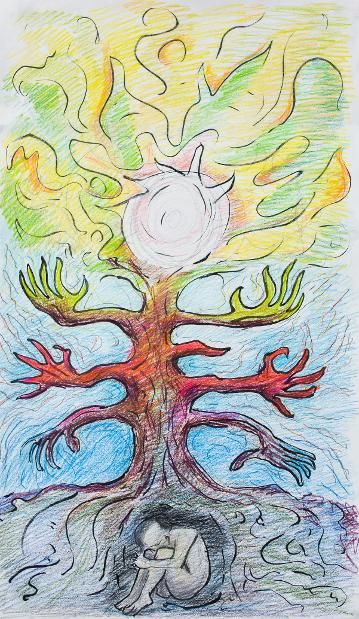
Art Map By David Keevil from https://www.youtube.com/watch?v=M-SVdQ-CHkA
The Four R’s:
Here’s a few steps to help.
- Recognize the autonomic state,
- Respect the adaptive survival response,
- Regulate/co-regulate into a Ventral Vagal state
- Re-story.
When you find yourself experiencing challenging situations:
- Notice where you are on the Polyvagal ladder; Ventral Zone, Fight/Flight or Dorsal Vagal Collapse.
- Name it
- Befriend the state, by turning towards it – Claim it
- Bring curiosity
- Listen for a moment to the story from the Ventral Zone, of the state – Tame it
Moving Into The Ventral Zone
“Earth will be safe when we feel in us enough safety.” Thich Nhat Hanh
It is not that we are continually in the ventral zone, as there are times where we will move into the other states. It is the ability to easily move back into the ventral zone. In developing our own autonomic intimacy we need a repertoire of activities, games, exercises, somatic experiences, and visual and auditory aids to utilise to assist returning in the ventral vibes zone in challenging times.
Activation of the ventral vagus nerve is associated with:
- feelings of care taking
- ethical intuition that humans from different social groups (even adversarial ones) share a common humanity
- feeling emotions that promote altruism – compassion, gratitude, love, and happiness
What are some activities that bring you back to the Ventral Vibes Zone? Write them down. Find activities that work for you…and if you like, add to the below list.
- dancing or movement ie hip hop,
- music making together, collaborative art making that sync our nervous systems
- play and imagine, dress ups, game making
- team sports that bring us into resonance with others,
- connection with nature,
- eye gazing, sex/lovemaking, connecting with others helping a friend. Co-regulating games using eyes, ears/sounds, voice, and facial movements. We are wired to connect!
- breathing exercises ie Pranayama breathing
- touch using Betty Martin’s 3 minute game, proximity seeking exercises,
- vocal bursts..ahhhhh, ohhhhh, hmmmm etc
- Develop a gratitude diary
Benefits of Autonomic Flexibility
We are continually reshaping the autonomic nervous system and the above exercises will help. By mastering staying in the Ventral Vagal Zone we
- Reduced inflammation and regulation of pro-inflammatory cytokines
- Control our immune response
- Able to Emotionally regulate our own nervous systems and others around us
- Ability to inhibit distractions
- Develop stress resilience
“Reshaping practices remind the autonomic nervous system that it has an inherent knowing about how to flexibly navigate the autonomic hierarchy”. Deb Dana
Putting it to the Test
Now that you have mapped out your own personal Polyvagal ladder, drawn an Art Map, and selected exercises, games, connection activities that help you move freely into the Ventral Vagal state lets put it to the test. Go back to the situation you remembered that caused collapse or the Fight/Flight response and use the somatic awareness when drawing and bringing awareness to each state to move out of that state by Naming it, Claiming it through befriending it, and Taming it, that is moving back into Ventral Vagal.
How did you go? Are there any adjustments needed? Now try another state and repeat the process.
This is your autonomic intimacy at work and can be engaged in anytime in distress, stuck on off, or your nervous system is mobilised.
You’ve got this!
Please share your Ventral Vibes below.
___________________________________________________
Bibliography
Armitage, Hanae, ‘Sound research: Scientific Innovation harness noise and acoustics for healing’. Stanford University.
Dana, Deb, Engaging the Rhythm of Regulation A Polyvagal Theory Guide to Safety and Connection, (September 9, 2019) DDP International Conference
Hip Hop Therapy Studio (June 29, 2021) Trauma Research Foundation