Modern attachment theory points to attachment towards a primary caregiver but what if we are missing a massive attachment piece? What if we contemplated a more indigenous perspective of attachment? What if we were actually hardwired to our natural environment? The weather, seasons and the food that is produced throughout those times of the year from the earth? Water and the waterways? The elements? Culture, language, rituals?
What if our perception of attachment has become one of reduction and we are bodies are really hardwired to the environment and we need to develop a more expansive conceptualisation of secure attachment that connects us to something larger than yourself, and a parent?
Who feeds us, shelters us, breathes us? Mother Earth, Life itself.
Who holds both our parents and ourself?
Rethinking attachment brings us back to being soothed, nourished and regulated by nature and water. Both Florence Williams (Nature Fix) and Wallace Nichols (Blue Mind) highlight in great scientific detail how we are hardwired to nature and the benefits of connecting to water and natural surroundings. Therefore when addressing attachment isn’t essential to then address our lack of connection, or deeper connection to nature and how we are moved, breathed and continually supported by the environment?
What changes in our body, in our consciousness, when we contemplate this level of expansive attachment?
Creating Your Day the moment you wake up changes neurological pathways You are that powerful! Create Your Day is a powerful technique that not only changes the brain but changes your experience of the world around you daily and what you attract. In an environment where many of us are trying to regain hope, humanise the digital age and stay connected with the true nature of oneself and to each other, “Creating Your Day” gives you hope brings about changes. It creates bigger changes the more you practice the technique.
Have you noticed that from the moment you wake up your brain searches for old memories, the list of what you have to do, how you feel about yourself, family, your work situation; in other words old neurological pathways. What if the moment you woke you changed what your brain thought? How do you think your day would be if you changed your thoughts the moment you woke?
How to Create Your Day
The moment you wake up take a moment to connect to what you really want from your day. What would make you happy having experienced at the end of the day looking back? Feel into how that would be if you experienced this. Then create announce to the day: “Today I will experience…..(add your order here).” ie ‘Today I will be meet new people”, “Today I will experience abundance like I have never known it, and all along the way I will be delighted by the day”.
Remember to only create what you are prepared to live!
This is not about changing habits as such rather it is about honouring that life says “YES” to our intentions from the moment you wake up, so let’s change our thoughts then get on with living.
The Healthy Mind Platter is a great foundation to start the year. Get this right and the body and healthy habits will follow.
New Year’s resolutions are fraught with failure, yet if we look at ourselves holistically then we can begin to develop healthy habits. The healthy mind platter developed David Rock and Dan Seigel gives a fundamental framework to develop rituals that are sustainable.
“The Healthy Mind Platter has seven essential mental activities necessary for optimum mental health in daily life. These seven daily activities make up the full set of ‘mental nutrients’ that your brain needs to function at it’s best. By engaging every day in each of these servings, you enable your brain to coordinate and balance its activities, which strengthens your brain’s internal connections and your connections with other people.“
Elements of the Platter
The seven essential daily mental activities are:
Connecting Time: When we connect with other people, ideally in person, or take time to appreciate our connection to the natural world around us, richly activating the brain’s relational circuitry.
Physical Time: When we move our bodies, aerobically if possible, which strengthens the brain in many ways.
Time In: When we quietly reflect internally, focusing on sensations, images, feelings and thoughts, helping to better integrate the brain.
Play Time: When we allow ourselves to be spontaneous or creative, playfully enjoying novel experiences, which helps make new connections in the brain.
Focus Time: When we closely focus on tasks in a goal-oriented way, taking on challenges that make deep connections in the brain.
Down Time: When we are non-focused, without any specific goal, and let our mind wander or simply relax, which helps our brain recharge.
Sleep Time: When we give the brain the rest it needs to consolidate learning and recover from the experiences of the day.
Your Healthy Mind Platter Exercise
Outline the elements of the healthy mind platter and needs
Brainstorm ideas for each element, allowing the ideas to simply flow without analysing. Write them down.
Evaluate Solutions that meet your needs
Choose solutions and times of the day that are most suitable for you to do this
Check Results weekly – make a time each week to check in and evaluate whether the solutions need to be updated
Start with Tiny Habits
We are bound to fail if we set our goals too high too fast without clear ideas how to support the habits changing and reinforcing the changes. We may have the motivation to start with but not the ability to do it or the trigger to develop the habit.
BJ Fogg outlines 15 ways to change behaviour over a long term period https://www.behaviorgrid.org So of these ideas are:
Modify your environment: includes your social, work environment
Make the habit small to start with so that training your body brain to make a habit automatic
Design not for the outcomes but the behaviour that leads to the outcome, therefore the healthy mind platter is a start to assist this. For instance weight loss there are many behaviours the contribute to the outcome ie stress reduction, eating habits, etc. Creating tiny habits change the end outcome.
Three things that need to happen to create behaviour change – High Levels of Motivation, ability to do it, Trigger (call to action). These three things together create change.
Develop your Own Format
Including Motivation, Ability and Trigger to develop a new habit you may want to try this:
“After I (existing habit – trigger)………., I will (new tiny behaviour)…………”
Following on from a habit you already have then add a new behaviour.
Tiny habits might be: “After morning coffee I tidy something in the house”. “Every time I walk in the door I will hug my partner”. “I will walk to work from the previous train station”
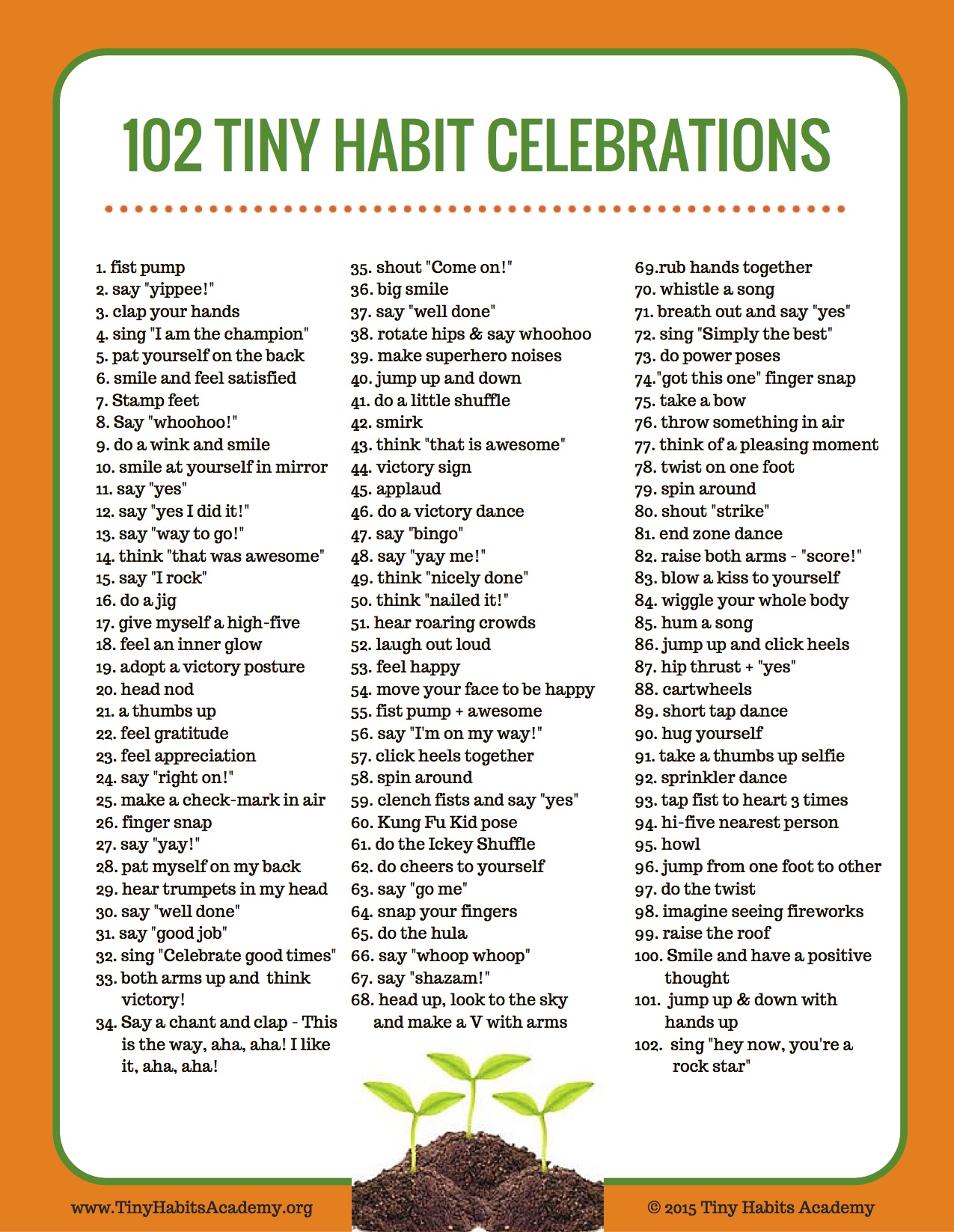
Remember to celebrate, find one that works for you, after every behaviour that you have changed. The more you do it the more you automate the behaviour.
Combining the Healthy Mind Platter enables you to look at your life, look at what you want to change, break it down into tiny behaviours and put it into right spots in your day combining triggers to remind you, and the behaviour will naturally grow.
Sharing Success
To support those tiny habits changing we would love to hear how you have gone, how you celebrate the little changes and your awesomeness. Add comments below……