Let’s talk about pleasure, sexual pleasure, your sexual pleasure. Let’s explore sexual arousal, passion, erotic desire, fantasies, attraction, sexual impulses and the untamed sexual drive.
“No bill of sexual rights can hold its own against the lawless untameable landscape of the erotic imagination.” Daphne Merkin
What are the implications of overly tamed sexual impulses? The mundaneness of routine sex? And the tendency to seek adventure outside long-term relationships, rather than exploring a renewed sense of sexual adventure within relationship?
Following on from the #meetoo campaign, there has been a great deal written about the misuse of position. This is not to dispute each claims validity, the abuse of power and the confusion inherent in these interactions. It is rather to highlight often unasked fundamental questions, questions not fully understood or addressed in our everyday encounters and relationship with our own sexuality. They simply are:
* Do I know what I want?
* Do I know how my sexual self works?
* Can I congruently communicate this to my sexual partner at the time?
It is urgent we cultivate a richer erotic intelligence with our own sexual self and with each other.
In her article “Bad Sex? No, It’s Girl Power Gone Wrong”, Janet Alberchtsen wrote:
“If Grace’s other sexual encounters are the same, she needs to ask how is a man meant to knowwhat she’s thinking when she doesn’t make it clear to him? When Ansari didn’t turn out to be Mr Darcy, Grace expected him to be capable of reading her mind. That’s a big enough ask and rather tricky when you’re not sure what’s in your own mind” (2018 p15)
Erotic intelligence requires us to navigate and embrace our unique sexual response system to keep us safe, as well as those with whom we are intimate. It requires us to separate inherited taboos and gender role inhibitions, and embrace the vibrancy and unpredictability of erotic passion rather than burying our desires and contracting ourselves to assumed mundaneness.
It is the ability to walk the unknown with confidence, to know the inner workings of our own sexual responses and be able to safely move between the erotic and safety, to ensure our sexual pleasure continues to flourish in the environment of innocence, adventurous exploration and mutual respect.
The Problem
Here lies the problem. If we don’t know what we want, like, or how our own unique internal sexual response system works, how are we going to convey this to our lover(s), husband, wife? How are we going to communicate verbally and physically through congruent cues, if the internal struggle between the Sexual Inhibition System (SIS) i.e., the sexual brake and the Sexual Excitation System (SES) i.e., sexual accelerator have not been resolved?
To make the science a little easier lets relabel the SIS as the ‘Safe Brain’ and the SES as the ‘Erotic Brain’.
How do they work together within you in order to respond to sexual stimulus? Does one rule over the other? What are the results of their interaction or separateness? How does this play out in our everyday sexual encounters? Are they culturally bound?
Meet the Guests
Let’s take Lucy for example. She has recently started dating again after 2 years, and has found that she sleeps with guys because they like her, but doesn’t really know if she likes them. She ends up being treated badly and no relationship is sustainable.
Mark finds himself so attracted to his partners that his body takes over and he premature ejaculates. This he finds embarrassing and has been denigrated for by his ex wife, which further erodes his sexual self-confidence.
Dot finds her interest in sex with her husband has diminished greatly after 15 years of marriage and she finds the same sexual routine boring and tedious. She thinks it might possibly be due to peri-menopause but is uncertain. She is concerned as to the consequence of her lack of interest in her relationship, especially since she has a new co-worker whom she fantasies about daily.
Joe at 60 years of age gets excited when there is an invitation to be sexually intimate with his partner, but when it comes to penetration he loses his erection.
Sarah has been a catholic nun her whole adult life and having never experienced sexual intimacy finds herself exhausted all the time.
The Question
The question that nearly always arises is “Am I normal?” The quick answer: YES! Emily Nagoski so eloquently put it:
“When you embrace your sexuality precisely as it is right now,
that’s the context that creates the greatest potential for ecstatic pleasure” (2015:p 6)
A Little Science
Before plunging further into the realm of sexual pleasure, here’s a little science.
The Dual Control model of human sexual response, developed by Erick Janssen and John Bancroft at the Kinsey Institute for Research in Sex, Gender and Reproduction, provides an organizing principle for understanding the true story of sex. It is a contemporary concept of mechanisms rooted in the central nervous system that controls human sexual behaviours. The idea is that sexual response is a result of the “interaction between sexual excitatory and sexual inhibitory processes.” In other words, some things push us towards sex and other things push us away from sex, and how we feel about sex at any given time depends on which force is currently greater.
“Your own SIS and SES, and their relationship to your mood or anxiety, are unique and individual. The goal of understanding your brake and accelerator is not to understand “what men are like” versus “what women are like” but to understand what you are like. Unique, with great potential for awesomeness.” Emily Nagoski
It turns out that sexual arousal, desire and orgasm are universal experiences. How we experience them depends on sensitivities of the sexual brake and accelerator, how they work together, and what stimuli they are given as to whether we feel turned on or not. The way our internal response system is organised is in no way better or worse than another; we are simply unique in our responses. We are all different. We are all the same. We are all normal.
What Is the Erotic Brain and Safe Brain?
Simplifying the science of sexual arousal we can colloquially call the SES the Erotic Brain, and the SIS the Safe Brain.
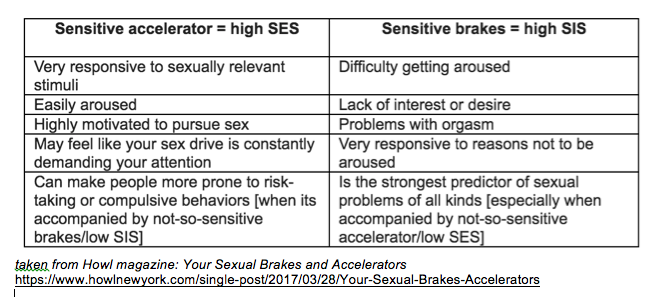
A. Erotic Brain = Sexual accelerator, (SES) Sexual Excitation System.
This is the Yes brain. What turns you on? The Erotic Brain:
* is where our sexual inhibitions are minimal, our sexual fantasies get to be played out, where there are very few boundaries, and gender roles are fluid.
* functions to pursue sexual desire.
* is continually scanning for opportunities, for sexually relevant material.
* sends signals to your brain through your senses that are sexually stimulating, turning you on.
* can have a low, medium or high sexual accelerator. High SES often means sex is most likely used to de-stress.
* also relates to how we can be beckoned, as Dr Stan Tatkin coins it, attracted through our senses.
B. Safe Brain = Sexual brake, (SIS) Sexual Inhibition System.
On the other side of the spectrum is the Safe Brain, the No Brain. What turns you off?
The Safe Brain can be the sum of all the personal, cultural and familial taboos, restrictions, beliefs and inhibitions you absorbed as a child. From a systemic perspective, sex is influenced by the generational stories and unacknowledged fates of those who came before. They are the stories of those who need to be seen and acknowledged that we play out and find ourselves often bound by.
The Safe Brain:
* consists of External and Internal brakes, when engaged can create low arousal due to internal fears (i.e., premature ejaculation) or external fears (i.e., pregnancy or STIs),
* continually scans for threats, whether perceived or real, filtering input influenced by beliefs and fears,
* scans the environment for reasons not to be aroused,
* sends neurological signals to the brain to turn off,
* can have low, medium or high sexual inhibition system.
* A high Safe Brain may view only certain conditions or environments as safe where you can feel relaxed and have a trusting elicit arousal.
* also can make us aware of how we can be beckoned in a way that works for us rather than turned off.
Esther Perel highlights the interplay between the erotic and the safe brain and our response to sexual stimuli by saying:
“Sex is vulnerable and risky; in this sense, there’s no ‘safe sex’..…..
Erotic passion is defiant and unpredictable – which leaves many people
feeling separate and vulnerable. (2003)
Erotic Brain vs Safe Brain – How they can work together?
Each brain comes with inherent qualities. If out of balance with one brain ruling more than the other, we find ourselves in situations that can be overwhelming, frightening or disheartening. Understanding our own internal erotic interplay creates safe and exciting ways to enhance and sustain a rich erotic life, especially if openly communicated to our partner(s).
The ability to understand our own unique sexual arousal system, through enquiring into the influencers that have contributed to the cultivation, for instance of a high accelerator or high brake, gives us the ability to change it. As Dan Siegel rightly exclaims, “Name it and you can tame it” (2014). Once this depth of acceptance and awareness is established within ourselves we are able to respond accordingly and educate our partners. This to many, means deeper connection that adds adventure and aliveness to our relationships. Furthermore, as Stan Tatkin often eludes to, we are able to add this information to developing a manual on how our partners work, in this case to our sexual arousal system.
Enquiring, into whether the influencers in developing our sexual arousal system are cultural, systemic, familial, religious or personal decisions, is essential to unravelling the interplay between both brains and to cultivating a collaborative internal experience. Such an interactive dance between the two brains can bring about a rich and fulfilling sexual adventure, a renewed sense of freedom and connection, not only within oneself as we accept our uniqueness, but also with our partner with whom we are able to connect more profoundly and playfully.
Returning Guests
Lets go back to Lucy whose Erotic Brain rules when she is dating, with little Safe Brain online. We could look at her inherent belief ‘if I don’t sleep with him he will leave’, or at how Lucy can de-stress in other ways than sex. We could have Lucy dialogue between her two brains to initiate a collaborative relationship so that her safe brain leads and the erotic brain follows, at least at the beginning of a relationship, allowing Lucy to discern what is safe and adventurous, with sustainability.
“People often end up in affairs to break from what they imagine is predictable boredom. Often when the “dull partner” ends up having an affair the other is surprised. This is because the supposedly familiar partner is in fact mysterious and unknown” Esther Perel (2015)
Mark, on the other hand, had his Erotic Brain taking over and was not working in collaboration with his Safe Brain or sexual brake. With no brake online, this meant his arousal heightened and resulted in premature ejaculation. A dialogue within him between the Erotic Brain and Safe Brain proved remarkably successful allowing Mark to no longer experience pre-mature ejaculation.
Esther Perel noted that in Dot’s case, one would challenge “the idea that security inside the relationship and adventure outside means pointing out that the familiarity we seek to impose on the other kills desire.” Does Dot have outdated cultural frames, hidden loyalties or familial experiences that have indicated that sex within marriage is boring, a duty and dies as we age? Often we see parents move to separate beds, complain about the other’s sexual desire and that they are not interested. Unfortunately children tend to take on this frame without question. In this case, the Safe Brain overly engages in certain settings and time frames. For instance, when a partner becomes pregnant we are not culturally inclined to view mothers as sexual. Cultural beliefs about age and sex also engage the Safe Brain which diminishes arousal.
From the perspective of New York Psychoanalyst, Stephan Mitchell, who wrote ‘Can Love Last?’ “Safety is presumed, not a given, but a construction” (2003)
“A sexual relationship is like learning a script neither of you has read. But you only notice this when one of you forgets your lines. And then, in the panic, you desperately try and remember something that you haven’t really forgotten. You hope the other person will prompt you. You start to hear voices off stage. You bring on another character.” Adam Phillips (1996:p)
The question bids to be asked, do you know how to enliven your partner’s passion and your own passion over time? Will your romance fade over time or become riskier?
This brings us to Joe whose sexual brake engages at the most precarious moment; when entering his partner he loses his erections. What has been his experience of sex? Why does his Safe Brain engage in “no” at such a delicious moment? What overshadows his sexual innocence that needs to be separated, explored and maybe left where it belongs? How can he engage his Erotic Brain during sex? What is the turn off?
Sarah, a Catholic nun, is the same, different and normal too. Her sexual brake was nurtured by her religious beliefs causing her Safe brain to rule and trap all her sexual energy. Sarah was unable to tap into this energy and utilise it on a daily basis in her responsibilities. Once she accepted that she also has an Erotic Brain, she felt more energised and was able to channel this sexual energy into her daily duties. Even nuns have Erotic Brains.
“If you’re having trouble with any phase of sexual response, it would be wise to start by asking yourself: “Is it because the accelerator isn’t being stimulated enough? Or… is there something that’s hitting my brakes?” — Once you know whether it’s a problem with the accelerator or the brakes, you can figure out how to create the change you want in your sex life.”
Emily Nagoski (2015:p50)
Furthermore,“[p]hysical pleasure offers a unique haven for many men and women; the soothing powers of the body make it the place for freedom of expression. It’s only during sex that they’re able to escape their anxieties and obsessive ruminations. The physical pleasure tunes out the numbing stress of the everyday. It provides solace and self revelation, along with a sense of connections.” Esther Perel (2003)
As Daphne Merkin suggests, the hindering of our erotic intelligence is epidemic because “in fact what most people don’t talk about when they talk about sex is still almost everything — everything, that is, that shakes up our reassuring notions of the normative, everything that doesn’t fit into the confining model of heterosexual adult behaviour endorsed by our progressive but underlyingly puritanical society”.
Which one rules you? Safe Brain or Erotic Brain? Take the Quiz in Emily Nagoski’s book ‘Come As you Are’ and discover for yourself. Then lets talk to each other about it!
Workshop
Brenda Sutherland is presenting ‘My Sexual Self & I” at the Australasian Constellation Intensive in Feb/Mrch 2018 in Sydney to find out more go to: http://constellationintensive.com/guest-presenters/
References
Alberchtsen, Janet, (2018) Bad Sex? No, It’s Girl Power Gone Wrong, The Weekend Australian 20-21 January.
De la Torre, Paula, (2017) Sexual Brakes and Accelerators., Howl Magazine, 29 March.
Cited https://www.howlnewyork.com/single-post/2017/03/28/Your-Sexual-Brakes-Accelerators
Janssen, Erick & Bancroft, John, (2007) The Dual Control Model: The Role of Sexual Inhibition and Excitation in Sexual Arousal and Behaviour. The Psychophysiology of Sex. Indiana University Press. Bloomington, IN. Retrieved http://www.indiana.edu/~sexlab/files/pubs/JanssenBancroft.pdf
Janssen E., Vorst H., Finn P., Bancroft J., (2002) The Sexual Inhibition (SIS) and Sexual Excitation (SES) Scales: I. Measuring sexual inhibition and excitation proneness in men. Journal Sex Research. May: 39(2):114-26. Cited https://www.ncbi.nlm.nih.gov/pubmed/12476243
Mitchell, Stephen (2003), Can Love Last? The Fate of Romance over Time, Norton Professional Books. http://icpla.edu/wp-content/uploads/2014/08/Mitchell-S.-Can-Love-Last-Safety-and-Adventure-Chap-1-Pp.31-57.pdf
Merkin, Daphne, (2000) Behind Closed Doors, The New York Times Magazine, 3 December. Cited http://www.nytimes.com/2000/12/03/magazine/behind-closed-doors-the-last-taboo.html
Nagoski, Emily, (2015) Come As You Are, Scribe Publications, United Kingdom.
Perel, Esther, (2003, 2014) Erotic Intelligence, Reconciling Sensuality and Domesticity., Psychotherapy Networker Inc., May/June. Cited https://www.psychotherapynetworker.org/magazine/article/832/erotic-intelligence
https://www.psychotherapynetworker.org/blog/details/415/erotic-intelligence
Phillips, Adam, (1996) Monogamy, Pantheon Books, New York.
Siegel, Dan (2014) cited by Dalai Lama Center for Peace and Education https://www.youtube.com/watch?v=ZcDLzppD4Jc
Take the Sexual Temperament quiz in Emily Nagoski’s book to find out how your SIS and SES work. http://www.emilynagoski.com/new-page/