“I want you to listen to me”, “I want you to stop talking to me like that”….sound familiar? Add your own request here that you often request.
Sam and Liz are both trying to prioritise their relationship goals. So Sam suggests they go camping more often, whilst Liz loves the theatre, neither agree on the solution as neither like the others idea. Yet each others needs have not been identified, only solutions to meet their needs. This is where conflict usually starts because both are trying to get a need met yet having identified it to them self and then each other. So now we have a conflict of solutions which leads to disappointment, frustration and disconnection in the relationship.
This is an all too familiar scenario nowadays, one that affects the way we connect and expect from each other. Fundamentally we are each trying to be understood, heard, and connect as well as feel as though we matter. Our disjointed communication is also filtered through our negative bias in the brain that is geared for war, thus often resulting in misunderstandings causing conflicts.
The usual scenario is that communication, requests start with being solution focused rather than needs focused, resulting in conflict of solutions without really knowing the need that is trying to be satisfied. Solutions are simply ways of attempting to get a need met.
“Communication is to relationships what breath is to life” Virginia Satir
Most of us do not know what need is trying to be met, so we come up with solutions for ourselves, or others without actually understanding the real motivation.
Now if Sam and Liz started with their needs then solutions would simply flow out of this understanding. SoWhat can be defined as a need? Abraham Maslow highlighted the basic hierarchy of needs in the 1940s, Max Neef expanded on these even further taking into consideration changes in social structure over time.
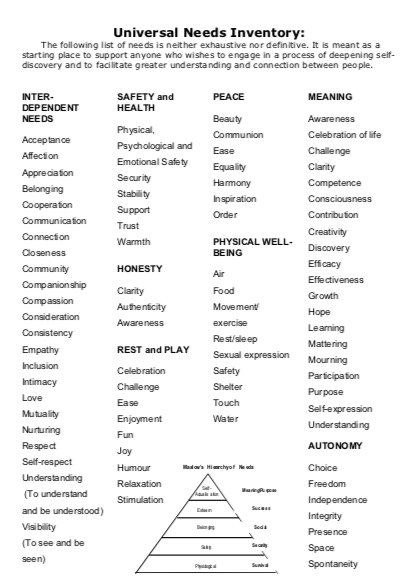
Needs can be grouped into 8 basic categories:
- Interdependent needs
- Safety and Security
- Peace
- Meaning
- Rest and Play
- Honesty
- Physical Wellbeing
- Autonomy
These categories were then further fleshed out. For example Autonomy further includes Choice, Freedom, Independence, Integrity, Presence, Space and Spontaneity.
https://awakening-com.s3.ap-southeast-2.amazonaws.com/2019/01/rcrmuwAn-Needs-Inventory.pdf
Self Check
So let’s start with finding one of your needs that did not get met. Think of a situation where you did not get your need met. What were the feelings that arose due to not getting the need met? What were the consequences of not getting that need met? How did this change the relationship with the other? Write them down.
Now think of a time where you did get your needs met. What were the feelings that arose due to getting the need met? What were the consequences of getting that need met? How did this change the relationship with the other? Write them down.
Now take a moment and ask yourself in both situations what were the needs trying to get met? Scan the list above to find one that resonates for you per situation. Now in that instance, now that I know the need, how could I have begun to give myself that need? How could I have communicated it to another? How could I have taken care of that need?
Take Two
Let’s come back to Sam and Liz as they begin to prioritise their relationship goals. What if they highlighted their respective needs first. ie Sam really wants to ensure that she matters (need) to Liz. Liz wants to feel as though she has autonomy (need) in the relationship with Sam. By understanding and shoring up their needs first they can brainstorm solutions together that work for both. Sam isn’t really into the theatre but loves going to the movies and of course the outdoors. Liz loves wining, dining and the theatre. So Sam and Liz decided that Liz would go with her friends to the theatre (autonomy needs being met) and that the both of them would have a picnic outdoors once a week just the two of them (the need to matter to the other being met). So both needs are met and there is no conflict of solutions.
Try it
Listening and feeding back the need to check if you have understood it correctly is the key first, whilst beginning to communicate your own. There is room for everyones needs here. Start with yourself first, as often we don’t even realise that we have needs that are trying to be met. Be honest with yourself. When you have a situation arise find out what need is trying to be met. Use the checklist above, the begin to communicate this first or in response to another.
When feeding back what the other is saying try by listening for the need and then check if have grasped it correctly. Here’s how:
- “Is it that you value (insert specific need)?”
- Or “It sounds like (insert specific need) is really important to you?”
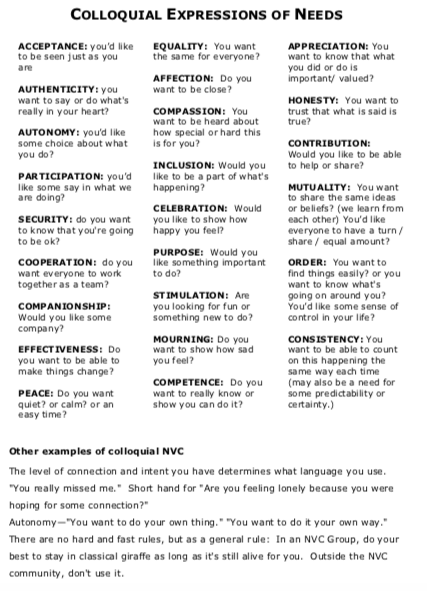
Now listen for the response and alter the statement based on what the person feeds back and try again. There is room for everyones needs here, so don’t forget to add your own. For example try:
- “I really value (insert specific need)”
- “What is really important to me is (insert specific need)”
Then add:
- “Would you be willing to consider coming up with solutions that work for both of us in this situation?”
Now you are onto something.
- Listen for the need, consider and include each others needs. Remember this is a win/win gig.
- Brainstorm solutions (don’t dismiss any) and then
- Mutually agree on a solution that works for both parties (if one compromises unfortunately there is often pay back)
- Implement the solution – decide when, how and where and when you will check in again to hear how it is working for the other
- Check results – did that work or do we need to refine our solution?
Remember to remain curious about your needs and the others.
By Brenda Sutherland (Founding Director of The Awakening Group)
For more information and further advanced communication training join us for our online communication training based on the Dr Thomas Gordon model. http://student-awakening.theteamserver.com/course/effective-communication-training-online/