
Category: Magazine

  • Little Equations Create New Communication Defaults

    Little Equations Create New Communication Defaults

    When I first started learning effective communication skills, I developed little equations in my head to help me construct a self-disclosure message, an active listening response, or a confrontative I-message.

    These little equations became a way of training my brain. With practice, the steps became familiar, and eventually the communication skills became more natural and automatic.

    I often work with clients and couples who have great difficulty recognising their feelings and needs, let alone finding the words to express them. This is where a few simple, repeatable steps can be incredibly helpful. We can literally train the brain to develop new neural pathways and create new habits for how we communicate.

    And it starts with self-empathy.

    Self-Empathy

    Self-empathy means turning your attention inward and becoming curious about what is happening for you.

    You might ask yourself:

    • What am I feeling?
    • What is happening for me right now?
    • What need is underneath this reaction?
    • What am I wanting, valuing or longing for?

    Before we can communicate effectively with another person, we need some capacity to understand ourselves.

    Many people try to communicate their experience without having a vocabulary for what they are actually feeling or needing. Instead, they jump straight to explaining what the other person is doing wrong.

    “You never listen to me.”
    “You don’t care.”
    “You’re so selfish.”

    These statements may express distress, but they don’t necessarily reveal what is happening inside us or the need that is trying to be met, or how the other’s behaviour is effecting us. Instead they create conflict as they are ‘YOU’ messages and the brain perceives this as a threat.

    Self-empathy gives us the opportunity to pause and discover what is underneath the reaction.

    What am I feeling? What do I need?

    Once we have some clarity, we can begin to share that experience with another person.

    Here is a feelings and needs list to support you to begin to familiarise yourself to expand from mad, sad and glad.

    Self-Disclosure

    Self-disclosure is the process of giving another person a glimpse into our internal world.

    Using effectiveness training, self-disclosure is about communicating your own experience rather than making the other person the problem.

    A powerful shift that builds relationships.

    Have you ever noticed how interested and connected your partner becomes when they get a genuine glimpse of what is happening inside you — particularly when they are not being blamed for it? There is something deeply connecting about being invited into another person’s inner world.

    A Simple Self-Disclosure Equation

    One little equation I use to help people practise this is:

    I + feel + fact

    For example:

    “I get really excited when I am able to express myself clearly.”

    Or:

    “I am saddened when I’m not able to communicate what I need.”

    The formula is simply a training tool. It helps you remember to speak from your own experience.

    Be Careful With the Word “Feel”

    An important part of learning self-disclosure is noticing whether the word feel is actually followed by a feeling.

    For example:

    “I feel that you are not listening to me.”

    The word feel appears in the sentence, but there is no feeling being highlighted as well as “you are not listening to me” is actually an interpretation or judgement about the other person’s behaviour not the facts.

    A fact is something you can see, hear or otherwise directly experience.

    For example:

    “When I we are talking and you looked at your phone, I am disappointed as I was eager to spend time with you”

    Now we have:

    Fact: Talking together, and looking at phone
    Feeling: disappointed and eager

    The focus stays with my experience, rather than becoming an accusation about your intention. That way we don’t force the other into conflict and we still get to express our disappointment.

    This small distinction can make a significant difference to how a message is received.

    Train Your Brain

    Communication is made of micro-skills that practiced over time changes the way we express ourself.

    Try this simple exercise:

    Send Three Self-Disclosure Messages Per Day

    Share three genuine self-disclosure messages with someone each day.

    They don’t have to be deep or complicated.

    You might share:

    “I’m really enjoying this coffee this morning with you.”

    “I’m a little nervous about today’s presentation.”

    “I’m really grateful that we’re having this time together.”

    “I’m excited about what we’re planning together .”

    “I’m tired and I need some quiet time this evening.”

    If remembering is difficult, attach the practice to something you already do.

    You could share your self-disclosure messages:

    • over your morning coffee
    • when you greet someone
    • when you send a text
    • when you arrive home
    • before going to bed

    The more you practise noticing your internal experience and putting it into words, the easier it becomes.

    You are not simply learning a communication technique.

    You are training your brain to create a new way of relating.

    And with practice, those little formulas can become something much more valuable than formulas.

    They become capacity.

    Capacity to know yourself.
    Capacity to express yourself.
    And ultimately, capacity to create deeper connection in your relationships.

  • Curiosity: The Game Changer in Relationships

    Curiosity: The Game Changer in Relationships

    The Game Changer in Relationships: Curiosity Over Justification

    There is a moment in almost every relationship conflict when the conversation reaches a fork in the road. It may begin with a forgotten phone call, an impatient tone of voice, an unanswered text message or the familiar words:

    “You never listen to me.”

    In that moment, there are two very different paths available.

    One path leads towards justification. The other leads towards curiosity.

    The difference between them can determine whether two people move into conflict drift or create connection.

    Most of us don’t consciously choose justification. It simply arises as a default as our brains are wired for war. As we read the signs, the sound of the voice, the frown, the eye roll and walking away our primitive parts of our brain engage and we go to war. Before we have even realised what is happening we start to defend ourself

    “That’s not true.”

    “I do listen.”

    “You don’t understand how stressful my day was.”

    “What about all the times I’ve been there for you?”

    Suddenly, the conversation is no longer about understanding one another or taking care of the space in the middle, that couple bubble, that connection.

    It becomes a courtroom. Each person presents evidence. Each person defends their intentions. Each person quietly hopes the jury will declare them innocent.

    Yet relationships rarely heal because someone finally proves they were right. And if you are fighting about memory ie who said what when, they you are both right and both wrong!

    We heal when someone becomes curious enough to ask,

    “Tell me more.”

    Why We Justify

    Justification is rarely selfish or uncaring. Most often, it is psychobiological.

    When we perceive we are being criticised, misunderstood or blamed, our sympathetic nervous system (fight and flight system) automatically prepares us for danger. Long before we consciously choose our response, our body has already begun responding as though we are under threat.

    Our heart beats faster. Our breathing becomes shallow. Our muscles tighten. Stress hormones such as adrenaline and noradrenaline prepare us to defend ourselves. Then the cortisol clicks in! Our reptilian brains evolve over thousands of years, a response that helped our ancestors survive physical danger, engages!

    Today, however, the greatest threats are often emotional.

    • A threat to our identity.
    • A threat to our belonging.
    • A threat to feeling loved.
    • A threat to believing we are enough.

    So when a partner says,

    “I felt hurt when you didn’t call,”

    our nervous system may hear,

    “You’re failing me.”

    “You’re a terrible partner.”

    “You’re letting me down.”

    Without even realising it, we stop listening for understanding and begin listening for danger. The brain shifts from connection to protection.

    The emotional centres responsible for detecting threat become highly active, while the prefrontal cortex—the part of the brain responsible for empathy, curiosity, perspective-taking and thoughtful decision-making—becomes less available.

    We are no longer asking, “What is happening for my partner?”

    Instead, our nervous system asks, “How do I protect myself?”

    And so we justify.

    “I was busy.”

    “I told you I had meetings.”

    “You know how stressful work has been.”

    Everything we say may be true, but truth spoken from a defensive nervous system does not meet a need to be heard, understood, acknowledgement, for connection, for safety and care.

    When Two Nervous Systems Go to War

    The moment one person needs to be heard and isn’t, their nervous system becomes activated too.

    • They speak louder.
    • You defend yourself harder.
    • They become more emotional.
    • You become more certain.
    • They pursue.
    • You withdraw.

    Or perhaps both of you fight.

    The original issue quietly disappears beneath two nervous systems desperately trying to protect themselves as well as get their needs met!

    What looked like an argument about dishes, money or a phone call has become something much deeper.

    It has become two human beings asking silent questions.

    Do I matter?

    Am I safe with you?

    Do you understand me?

    Do I matter to you?

    Will you reject me?

    Will you choose me?

    Genuine intimacy requires enough safety for people to remain present with themselves and with one another, even when difficult emotions arise. When the nervous system becomes overwhelmed, curiosity naturally narrows and self-protection takes over.

    This is why telling your partner to “calm down” rarely works! Yet shifting gears to hear the need that is trying to be met does.

    An activated nervous system cannot simply be reasoned into feeling safe. Sometimes healing begins by slowing everything down.

    • Breathing.
    • Softening our voice
    • Sitting down and facing each other
    • Waving the flag of friendliness before you go offline
    • Taking a break and coming back when regulated to discuss the issues

    The Hidden Longing Beneath Every Argument

    One of the greatest shifts whether we are a couple, a parent, a daughter, sibling, colleague or employer, we can make is learning to hear what sits beneath the words. Listening for feelings and needs trying to be met.

    When someone says,

    “You never help me,”

    perhaps what they are really saying is, “I feel lonely and need support”

    “You don’t care about me.”

    may actually mean, “I want to matter to you”

    “You’re always on your phone.”

    may really be saying, “I miss connecting with you”

    Justification responds to the accusation.

    Curiosity listens for the longing, the feelings and needs.

    This is why curiosity is so powerful as it maintains connection whilst taking care of the space in the middle and not default to pro-self.

    Rather than asking, “How do I prove I’m right?” it quietly wonders,

    “What pain am I hearing underneath these words? What need is trying to be met?”

    Shifting Gears: From Defending to Listening

    Curiosity is more than asking good questions. It is learning to shift gears.

    When we become defensive, we naturally listen for mistakes in our partner’s story. We prepare our response before they have even finished speaking.

    • We interrupt.
    • We explain.
    • We defend.

    Curiosity asks us to able to hold the tension enough to temporarily put our own story aside, for a moment, and become deeply interested in the others.

    This is where active and empathetic listening become transformational.

    Active listening means being present and feeding back the feelings and facts that are trying to be expressed.

    Empathetic listening goes even deeper.

    It listens for feelings and unmet needs embedded in the longing beneath the behaviour and words.

    Instead of responding with defensiveness when you hear:

    “You never listen,”

    we begin by responding by saying

    “It sounds like you are eager to be heard around this?”

    Or

    “Is it that you are anxious as you would really like to connect?”

    Notice that none of these statements require agreement and there is no “I” as you have left the message with the other.

    It is simply communicating to gain understanding first.

    It is only after we have gained understanding of the other and we are on the right track not consumed by assumptions, do we gently offer our own experience in the form of feelings and needs.

    “Thank you for sharing that. Would you be willing to hear my experience about the situation?”

    This is one of the beautiful paradoxes of relationships.

    The fastest way to be understood is often to help the other person feel understood first.

    Your feelings matter equally. But two activated nervous systems cannot truly listen at the same time. Someone has to shift gears first.

    Curiosity Is Not Surrender

    Many people worry that curiosity means admitting they were wrong.

    It doesn’t.

    Curiosity is not agreement.

    It is not accepting blame for something you didn’t do.

    It is not tolerating abuse.

    Curiosity simply says,

    “Your experience matters enough for me to understand it before asking you to understand mine.”

    There is enormous strength in that. Because when people feel emotionally safe, they naturally become more curious about us in return.

    From Winning to Repair

    Healthy relationships are not built because we avoid conflict. They are built because we learn to repair after conflict., and quickly.

    Repair begins when we recognise that intention and impact are often different. You may never have intended to hurt someone. Yet they may still have experienced hurt.

    One simple sentence can change the entire direction of a conversation.

    “It looks like that really upset you?”

    That is not admitting malicious intent. It is acknowledging another person’s reality. And sometimes that is all the nervous system needs to begin relaxing.

    Protecting the Relationship Instead of Protecting Yourself

    The next time conflict begins, notice the moment you feel the urge to defend yourself.

    Pause. Get curious!

    Take one slow breath.

    Notice your body.

    Then ask yourself one question.

    “Am I trying to protect my position, or am I trying to protect this relationship?”

    Transformation does not emerge through pressure or persuasion, it emerges with tiny habits and grows from presence and emotional safety. It grows when curiosity becomes stronger than justification.

    Because perhaps the greatest act of love is not having the perfect answer. It is having the courage to remain curious.

    To listen before explaining.

    To understand before correcting.

    To reflect before reacting.

    To protect the relationship before protecting your ego.

    So before saying,

    “But…”

    pause. Ask,

    “Help me understand what is going on for you.”

    Listen for the feelings.

    Listen for the needs.

    Listen for the longing beneath the words and behaviour.

    Then, once the other knows they have been heard, gently share your own heart.

    Because love is rarely strengthened by proving who was right. It is strengthened when two people feel safe enough to stop defending themselves and begin discovering one another again.

    That is the quiet power of curiosity.

    And sometimes, it is the doorway that leads two people home to each other, to security, mutuality and respect.

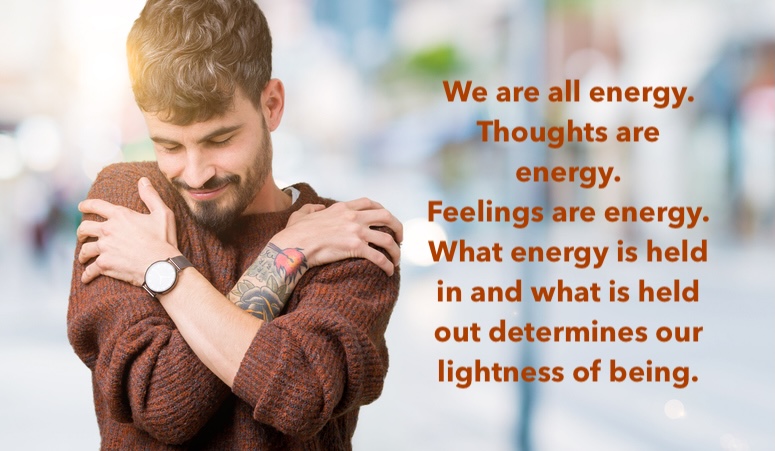
  • What is Held In and What is Held Out?

    What is Held In and What is Held Out?

    Many years ago, whilst immersed in a silent retreat, in the bathroom of all places, I asked a question as my partner at the time walked past. The answer resulted in everything disappearing, and I experienced that we are consciousness itself. I saw how lifetimes don’t exist, there is no time and no space it is simply all now, I saw how we are never born and never die — only the body does. I have never been the same since.

    The question was: How can I experience nothing when my enlightened teacher walks past, and nothing when my partner walks past?

    My whole being replied, “Because you are nothing.”

    I laughed so deeply and with pure joy that everything disappeared.

    As a therapist, and for many gurus, how do you invite someone — including yourself when the ego takes over again — to that place of consciousness itself? Simple, sublime; there is nothing and everything at the same time. We can point to it, yet the moment the mind tries to grasp it, we are back in the mind.

    How do we navigate feelings, thoughts, and pain bodies enough to quieten them so we can experience what never leaves us, what the mind continually overlooks in its searching?

    I have discovered a technique that honours the premise that we are simply energy vibrating at a certain frequency. Scientists understand this in terms of viruses. Each virus vibrates at a certain frequency. Thoughts vibrate at a certain frequency, and we can observe their effect on water. Feelings vibrate at a certain frequency, and we experience their effects within our bodies.

    They are like radio waves moving through us, but sometimes they get stuck and we begin vibrating at that frequency. This can be distressing because it is not the vibration of who we truly are. We call this suffering.

    This is what we hold in.

    Which also raises the question:

    What do you hold out?

    What delicious feelings, experiences, and sensations do you hold out?

    If radio waves come and go, then the good stuff moves through you too.

    Joel Young created a very quick technique called ‘Non-personal awareness’ that the mind will likely dismiss because of its simplicity. Yet it is a powerful process that meets the frequency of the thought, feeling, or pain body and disengages it from our being — in other words, sending it back where it came from, letting it move through you easefully.

    Want to know how?

    It is simple.

    It involves six sentences.

    Yep. Simple and elegant.

    Here’s how

    1. Firstly, grab a pen and paper, or journal or your phone so you can record your own dialogue.
    2. Secondly, think of something that challenges you, constricts you, that you hold in. Just vomit it onto the page, or by speaking into your phone on record, and see what words, feelings, behaviours, thoughts, sounds, movements appear that are paramount, repeated. What is the fundamental thing. It does not have to make sense. You do not have to analyse it or figure it out, it is just energy stuck.
    3. Take one of these which may have sounds and movements with it , without analysing it or trying to understand it or find parallels with your childhood, no interpretation needed, simply bring it into these sentences. For example, I may have deep feeling that people don’t care about me and a hand movement, and a sigh that goes with it.
      • Simply say (whilst adding the sigh and hand movement)
        • This people don’t care about me
        • This energy people don’t care about me
        • This pure energy people don’t care about me’
        • ‘This pure energy people don’t care about me is not personal’ (3 times)
        • This pure energy people don’t care about me is not personal’
        • This pure energy people don’t care about me is not personal’
        • This pure energy people don’t care about me is not personal and I am willing to experience it’
    4. Allow space for the sensations to arise, you can go as slow as you like. You may say the last sentence again.
    5. Wait until you feel the clarity appear again and maybe a natural aliveness arises.
    6. Now if energy is held in and it flows out, what is held out? What energy would you like to replace the energy that was held in that has now gone with? Maybe joy, ease, love, peace…find yours. Sometimes it arises naturally after the first part of the exercise. For example: ‘Connection’ arose after the first part of the exercise.
    7. Take this feeling, sensation, whatever it is and bring it into the same sentences:
      • Simply say (adding your feeling in)
        • ‘This connection’
        • ‘This energy of connection’
        • ‘This pure energy of connection’
        • ‘This pure energy of connection is not personal’ (3 times)
        • This pure energy of connection is not personal and I am willing to experience it’

    Simply notice what happens.

    There is no need for analysing, interpretation, or fixing.

    Simply experience the energy moving through you.

    Some people have trauma leave their body, which can be overwhelming, I would simply allow the body to shake, cry and not to fear the movement of the energy. Simply repeat the sentences slowly.

    30 Day Challenge

    In this time in history, we are continually bombarded by radio waves — information, thoughts, pain bodies, feelings, and countless electronic frequencies that can interfere with our connection to our own true vibrational frequency.

    Perhaps this is an opportunity.

    An opportunity to allow these energies to move out and to let who you truly are move in.

    So here is the challenge.

    For 30 days, use your phone, journal, or a piece of paper and spend just a few minutes each day with this process.

    Notice what you are holding in.

    Everyday bring something that you hold in to the challenge by using the non-personal awareness exercise. Remember to invite yourself to experience what you hold out too after you have completed the first round, or a few rounds of what energy you hold in.

    You may discover that the thoughts, feelings, stories, and sensations that once seemed so personal are simply energy moving through awareness.

    Perhaps beneath the noise, beneath the stories, beneath the endless radio waves moving through the mind and body, there is a natural clarity, aliveness, peace, love, connection, or joy waiting to be experienced.

    Not because you created it.

    Not because you earned it.

    But because it is already here.

    The challenge is simple.

    Thirty days.

    A few minutes a day.

    Six sentences.

    And a willingness to experience what arises.

    See what happens.

    Let’s share the energy and add your comments below