Tag: The Work of Byron Katie

  • FREE Introductory Evening to Holistic Counsellor Training 2026 programs

    FREE Introductory Evening to Holistic Counsellor Training 2026 programs

    Welcome to a fun online  introductory evening where you get to:

    • Meet the founder of this 26 year old, 5 star Holistic Counsellor program
    • Meet students
    • Experience a number of the techniques taught throughout the program
    • Find out more about the training program
    • Ask questions

    To Register for Zoom Evening  CLICK HERE

  • Finding Freedom Through Four Questions: My Experience with The Work of Byron Katie

    Finding Freedom Through Four Questions: My Experience with The Work of Byron Katie

    I remember the moment clearly. I was sitting in my car, parked just outside my apartment, staring blankly through the windshield. My mind was spinning with thoughts like a stuck record: He shouldn’t have said that. How could he treat me that way? I’ve given everything to this relationship. I felt angry, heartbroken, and utterly powerless and my my was relentless!

    That’s when I remembered The Work of Byron Katie.

    I’d heard about it before — a simple process of inquiry that invites you to examine your stressful thoughts. Four questions and a few “turnarounds” that somehow help people find peace, even in the most painful situations. At the time, I was skeptical. How could four questions possibly help me untangle this mess?

    Still, I was desperate enough to try as I just wanted peace.


    Starting Self Enquiry with The work

    I took a deep breath, pulled out my journal, and wrote the thought that was hurting the most:
    “He doesn’t care about me.”

    Then I asked the first question:
    1. Is it true?

    My immediate reaction was Yes, of course it’s true! But I knew the process was asking me to slow down. So I sat with it and went into my heart.

    2. Can you absolutely know that it’s true?
    This question cracked something open. Absolutely know? No. I couldn’t. I could assume, guess, interpret — but I didn’t know what was going on in his heart.

    3. How do you react — what happens — when you believe that thought?
    That was easy: I shut down. I stew in resentment. I rehearse arguments in my head. I build a case against him. I isolate. I become someone I don’t like.

    4. Who would you be without the thought?
    Without the thought “He doesn’t care about me,” I imagined myself sitting in the car feeling hurt, yes — but without the added poison of judgment. I could allow the pain of the moment without turning it into a story of betrayal. I might even be open to curiosity or compassion — for myself and for him.


    Turning it Around and Bringing Peace Home

    Then came the turnarounds. This is where you take the original statement and flip it in different directions to see what else might be true.

    • “He doesn’t care about me” became:
      • I don’t care about me.
      • I don’t care about him.
      • He does care about me.

    Each one felt uncomfortable as I met reality, but interesting. I explored them askign myself where these turnarounds were truer than my stressful thinking:

    • I don’t care about me — I realized I’d been abandoning myself emotionally, outsourcing my well-being to his approval. That stung, but it was empowering too. If I was the one neglecting myself, maybe I could also be the one to care for myself.
    • I don’t care about him — I had been so caught up in being right that I hadn’t tried to understand where he was coming from. That didn’t excuse his behavior, but it reminded me that I had shut down empathy.
    • He does care about me — This one was hard to accept at first. But then I remembered times he’d shown care, even subtly. The story wasn’t black and white.

    A Quiet Shift

    I didn’t walk away from that inquiry with a perfect resolution. The relationship still had its problems. But I walked away with something more valuable: clarity, peace and meeting reality as it is rather than my head arguing with it and making up stories that kept me awake all night.

    The pain wasn’t just coming from the situation — it was coming from my unquestioned thoughts about it. The Work didn’t change what happened, but it changed how I experienced it. And that shift made all the difference.

    I’ve used The Work many times since that day. On thoughts like “I’m not good enough,” “They’re judging me,” or “This shouldn’t be happening,” or “Somethings wrong with me.” Each time, the process feels like holding a mirror up to my mind — not to judge it or shame it, as minds do what minds do, but to understand it. To loosen the grip of stories that keep me stuck and stressed.


    Why It Works

    The beauty of The Work is in its simplicity. Byron Katie doesn’t ask us to suppress our thoughts or replace them with positive affirmations. She simply invites us to question them — deeply and honestly. And in that questioning, space opens up.

    What I’ve learned is that truth, when it’s discovered rather than imposed, is incredibly kind. It doesn’t scold. It doesn’t shame. It just reveals what’s been hidden by fear or habit.

    And in that light, even the most painful thoughts can begin to dissolve.


    Final Thoughts

    If you’re struggling with a painful situation or a recurring belief that keeps you small or stuck, I encourage you to try The Work. Start with one stressful thought. Ask the four questions. Turn it around. See what you find.

    You might not get fireworks. But you might get something quieter and more lasting: peace.

    And sometimes, that’s enough to change everything.


    Suggested Reading

    • Katie, B., & Mitchell, S. (2002). Loving What Is: Four Questions That Can Change Your Life. Harmony Books.
    • The Work of Byron Katie. (n.d.). Thework.com. Retrieved from https://thework.com
    • Katie, B. (2007). I Need Your Love—Is That True? How to Stop Seeking Love, Approval, and Appreciation and Start Finding Them Instead. Harmony Books.
    • Katie, B. (2008). Question Your Thinking, Change the World: Quotations from Byron Katie. Hay House.
  • The Neuroscience of Enquiry: How 4 Questions Can Rewire Your Brain

    The Neuroscience of Enquiry: How 4 Questions Can Rewire Your Brain

    Have you ever caught yourself spiralling into stress over a single thought? Maybe it’s “I’m not good enough,” or “They don’t respect me.” That one belief, left unchecked, can shape your emotions, your reactions, your body and even your relationships.


    A single unchecked thought can hijack your entire nervous system! One moment, you’re fine, and the next, you’re spiralling—heart pounding, stomach in knots, mind racing through every worst-case scenario like it’s training for the apocalypse.


    But what if questioning your thoughts could actually change your brain?
    This is where The Work of Byron Katie comes in—a deceptively simple practice that has profound effects on how we think, feel, and respond to life. And science backs it up. From neuroplasticity to emotional regulation, The Work of Byron Katie provides a profound mechanism that can reshape the brain.

    How Stressful Thoughts Get Stuck in the Brain


    Think of your brain like a well-worn hiking trail. Every time you believe a stressful thought, your brain strengthens that pathway and it gets more entrenched. It works like this:
    Negative Thought:“They don’t respect me.”
    Emotional Reaction: Anger, sadness, or withdrawal.
    Brain’s Response: The amygdala (your brain’s threat detector) lights up, reinforcing the belief.
    Cycle Continues: Over time, this thought becomes transparent and automatic.
    Your brain is designed to be efficient—it wants to protect you, so it strengthens beliefs that seem to “keep you safe.” The problem? Many of these thoughts aren’t true. They’re just interpretations of a reality.

    The Work as a Brain-Rewiring Tool


    Byron Katie’s four questionsand turnarounds might seem too simple to be life-changing, but let’s look at what they actually do to your brain:


    1️. Is it true? Interrupts automatic thinking. Forces your prefrontal cortex (the logical part of your brain) to pause instead of reacting.


    2️. Can you absolutely know that it’s true? Creates cognitive flexibility. The brain starts loosening its grip on rigid beliefs, making space for alternative perspectives.
    The first two questions force your prefrontal cortex (the rational part of the brain) to slow down and reconsider automatic assumptions. Our executive functioning, those ambassadors come back online. 


    3️. How do you react when you believe that thought? Activates self-awareness. Your body’s stress response becomes visible—this is where real change begins. The third question builds metacognition, making you more aware of how your thoughts shape your emotional state.


    4️. Who would you be without that thought? Stimulates neuroplasticity. Your brain starts rewiring new pathways, shifting toward calm, clarity, and curiosity.
    And then comes the turnarounds—a plot twist for your mind. Instead of clinging to one rigid perspective, or that well worn hiking trail, you flip it:


    “They don’t respect me” → “I don’t respect them” → “I don’t respect myself.”


    Wait, what? Now, instead of being trapped in blame, you have an opening. A chance to see the situation differently, to experience it differently in the body, have choices again as you begin to find where that is true in your life. 
    Over time, practising The Work weakens old, stress-inducing feedback loops and strengthens new ones based on curiosity, openness, and clarity.

    Meet Sarah: The Thought That Changed Everything


    Imagine Sarah, a university student caught in a relentless loop of self-doubt. Every time she sits down to study, a familiar thought creeps in: “I’ll never be successful.” The more she believes it, the heavier it feels—anxiety sets in, motivation fades, and the cycle tightens its grip.
    One day, she comes across The Work of Byron Katie and, almost sceptically, asks herself the first question: “Is it true?” For the first time, she pauses. Can she absolutely know that it’s true? The certainty begins to crack. As she moves through the four questions, something shifts. The thought that once felt like an absolute truth now feels… optional.
    Her turnaround? “I am successful.” (In truth, there are already ways in which Sarah is successful and is a success and her brain starts to spark (those synapses start rewiring) as she remembers many. Success is not a fixed outcome but an ongoing process).
    OR
    “ I am a success”. (In truth, success isn’t only measured by external achievements. Sarah has grown, learned, and accomplished things in many ways that matter).
    This is not a forced affirmation, but a quiet recognition of truth and endless possibilities.

    Weeks pass, and Sarah notices something strange. The old thought still visits, but it no longer controls her. Anxiety loosens its grip. Motivation returns. Her brain—once locked in self-criticism—is learning a new way forward, not through blind positivity, but through the simple act of questioning the stressful thoughts to see if they are valid or true or not!

    The Science of Inner Freedom


    The beauty of The Work of Byron Katie isn’t just in the relief it brings—it’s in how it rewires the brain for lasting change.
    Reduces emotional reactivity: By calming the amygdala.
    Strengthens cognitive flexibility: By activating the prefrontal cortex and executive functioning.
    Promotes resilience: By fostering new, empowering thought patterns.
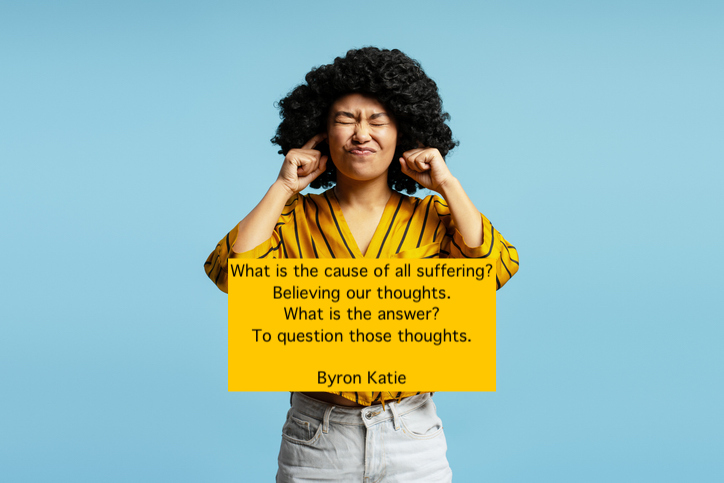
    As we dive into the neuroscience of The Work, one fundamental truth emerges: thoughts, in themselves, are neutral. It’s our unquestioned belief in them that causes suffering. When we believe a stressful thought, our brain reacts as if it’s reality—triggering the amygdala, fuelling stress hormones, and reinforcing well-worn neural pathways.

    But as Byron Katie reminds us:
    “A thought is just a thought. It’s not personal until you believe it.”


    This is where The Work becomes so powerful. By questioning our thoughts, we loosen their grip, interrupt the brain’s automatic stress responses, and create space for clarity. Instead of being held hostage by our thinking, we step into the role of observer—curious, open, and free.
    The next time a thought tightens its grip, turn toward it with curiosity. Let these four questions be lanterns in the fog, unravelling the illusions that bind you, rewiring your mind, and leading you back to the freedom that was always yours.

    ~ Written by Ami Besson (Integrative Therapist at The Awakening Group)